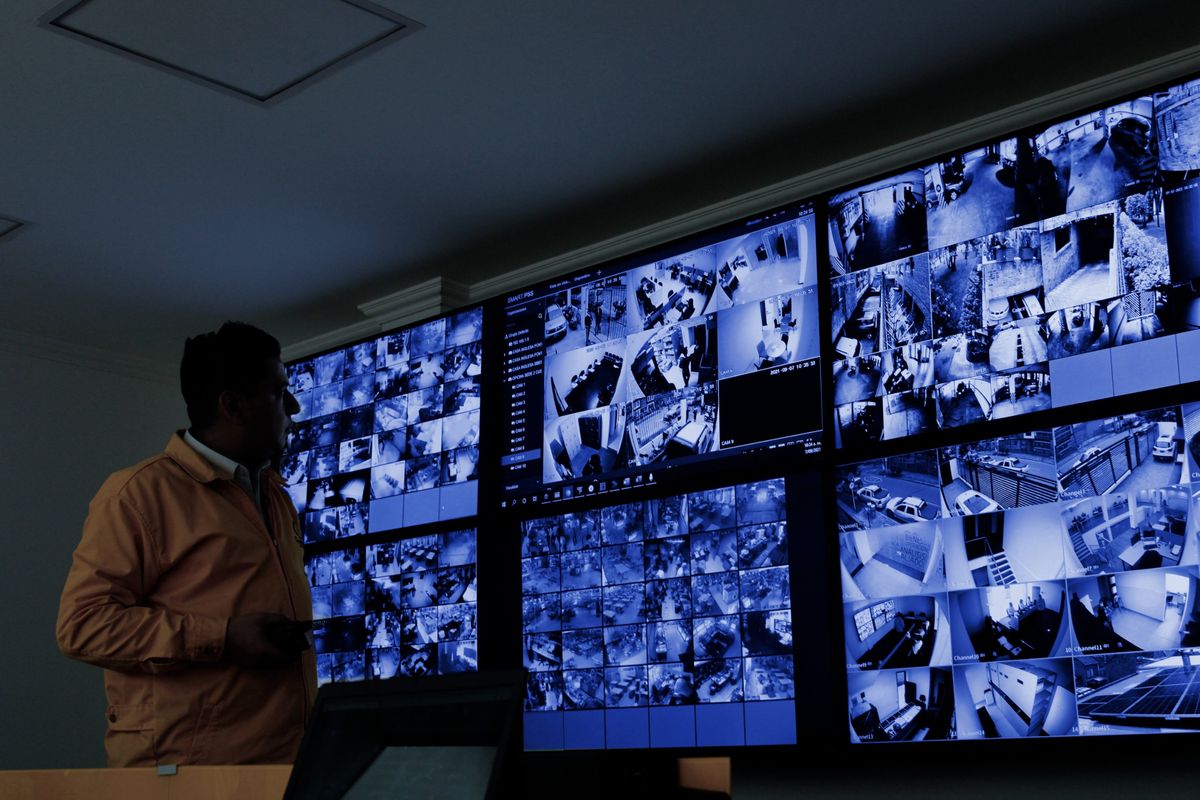
Remote concierge is a service in which trained operators, from a 24/7 monitoring center, receive visitors and control access through cameras, audio, intercom and access control, with remote opening, digital logging and response protocols. It suits condominiums, buildings and companies with well-defined access points that seek continuous coverage, traceability and a more efficient security scheme, always with connectivity redundancy and physical backup response.
In recent years, more and more residential complexes, office buildings, warehouses and business parks in Colombia are asking the same question: can we maintain rigorous 24-hour access control without depending solely on an on-site front desk? The answer is usually "yes, with proper design," and the tool is remote concierge.
What is remote concierge?
Remote concierge (also called virtual concierge) moves entrance attention to a monitoring center. There, trained operators verify who arrives, validate their authorization and open or deny access remotely, supported by cameras, two-way audio, digital intercom, readers and logging software.
It is not a camera that "watches on its own." It is a security service with people, processes and technology working in a coordinated way. Under Decree 356 of 1994, technological means are a recognized way of providing the service, and for unarmed services the regulation contemplates monitoring centers, closed-circuit systems and access controls (art. 47).
How does it work step by step?
- Arrival of the visitor or supplier. They announce themselves at the access point with an intercom or a reader.
- Video and audio verification. The operator sees and identifies the person or vehicle and checks whether they are on the authorized list.
- Validation with the host. Confirm with the resident, the department or the person in charge by call, app or message.
- Controlled remote opening. If everything matches, entry is authorized; if not, it is denied and the attempt is recorded.
- Record and traceability. Every event is recorded with date, time, image and responsible operator, available for audits.
- Handling of alarms and incidents. In the event of an incident, the control center activates the protocol: verification, notification of the person in charge and, if necessary, on-site response.
Traditional concierge vs. remote concierge
| Aspect | On-site concierge | Remote concierge |
|---|---|---|
| Coverage | Depends on shifts and relief at the post | 24/7 control center serving one or several access points |
| Traceability | Manual logbooks and records | Digital record with image, time and operator |
| Verification | Judgment of one person on post | Standardized procedure backed by video |
| Immediate physical response | Present on site | Requires a round, supervisor or backup response |
| Technical dependency | Low | High: requires backed-up connectivity and power |
| Scalability | One post per access point | One control center can serve several sites |
| Cost over time | Recurring personnel cost per post | Initial technology investment and recurring monitoring service |
Qualitative comparison. Actual cost depends on each site; request a total-cost simulation over a horizon of several years.
Advantages for companies and condominiums
- Continuous coverage: service does not depend on absenteeism or shift relief at the post.
- Stricter control: one verification protocol for every entry, with video evidence.
- Auditable traceability: reports by date, visitor, supplier or event for security, purchasing and audit departments.
- Resource efficiency: staff can be reassigned to higher-value tasks, such as rounds and supervision.
- Integration: connects with CCTV, alarms, vehicle and pedestrian access control and video analytics.
Limitations and risks you should consider
A good provider will tell you before selling you anything:
- Connectivity and power: without internet and backed-up power (link redundancy, UPS, generator) the service degrades. It is the most important technical point.
- It does not replace physical response: in an emergency, someone must get to the site. Define who, from where and how quickly.
- Change of habits: residents, employees and suppliers must know the new procedure; training and communication are part of the project.
- Personal data: images and entry records are personal data and must be handled in accordance with Law 1581 of 2012: privacy notice, defined purpose, restricted access and controlled retention.
When does it make sense and when does it not?
| It usually makes sense when… | Requires additional analysis when… |
|---|---|
| Access points are well defined, with good lighting and visibility | The property is very large, with multiple informal access points |
| The flow of visitors and suppliers is manageable and predictable | There is cargo reception or volumes that require constant physical presence |
| Traceability and standardized procedures are sought | The site's connectivity is unstable and cannot be improved |
| You want to combine technology with rounds and supervision | The risk calls for armed personnel or permanent visible deterrence |
In many cases the best solution is hybrid: remote concierge for access control, plus rounds, supervision and a response point. A risk analysis up front avoids over- or under-sizing the solution.
What a serious remote concierge solution should include
- Security company with a valid license and a service authorized by the Superintendence of Surveillance and Private Security.
- Monitoring center staffed 24/7 by trained operators, with written protocols.
- Cameras with good resolution, two-way audio and, where applicable, video analytics.
- Connectivity redundancy and backup power on site.
- Integration with pedestrian and vehicle access control and with existing alarms.
- Recording with defined retention, restricted access and traceability of queries.
- Physical response plan: rounds, supervisor or on-site support.
- Periodic reports and indicators agreed in the contract.
- Compliance with Law 1581 of 2012 in the handling of images and records.
Legal framework: what you should keep in mind
- Decree-Law 356 of 1994: providing private surveillance and security services requires a license from the Superintendence (art. 3) and allows technological means (art. 5).
- Law 1581 of 2012 and implementing regulations: personal data protection regime; it applies to cameras, biometrics and visitor logs.
- Law 675 of 2001 (horizontal property): in complexes and buildings, changes to the security scheme are handled according to the by-laws and the decisions of the assembly or council. Consult your administrator and legal advisor.
How to implement remote concierge in 6 phases
- Diagnostic and risk analysis. Entry flows, schedules, user profiles, infrastructure and threats.
- Solution design. Cameras, readers, intercom, connectivity, backup and protocols.
- Installation and integration. With existing systems and communication tests.
- Tests and drills. Scenarios of internet failure, power failure and security events.
- Transition and training. Communication to users, authorized lists and accompaniment period.
- Operation and continuous improvement. Periodic reports, indicators and adjustments.
Questions to ask your provider
- What happens if the internet or power goes down? How long does it take for operations to be restored?
- Who responds on site and how quickly?
- How do they protect images and records, and for how long do they keep them?
- What indicators do they give me and how often?
- What happens to my equipment if the contract ends?
Remote concierge with Custodiar CyberGuard™
Custodiar CyberGuard™ is Custodiar LTDA's 24/7 remote concierge solution: operators in a control center verify visitors, access and events through video, audio and access control, with digital logging and response coordination. It integrates with electronic security (Tec™), on-site surveillance (Protect™) and systems integration projects (Integra™), to design a hybrid scheme tailored to each operation.
Is your access point a candidate for remote concierge?
We evaluate your operation, your entry flows and your infrastructure, and tell you honestly whether it makes sense, what adjustments it requires and how it integrates with your current security.
Discover CyberGuard™ → Message us on WhatsAppFrequently asked questions
What is remote or virtual concierge?
It is a service in which operators in a monitoring center handle the access points of a building, complex or company through cameras, audio, intercom and access control, with remote opening, digital logging and response protocols.
Does remote concierge work 24 hours?
Yes, when the monitoring center operates 24/7. For the service to be continuous, the site needs backed-up connectivity and power, and a physical response plan for emergencies.
What happens if the internet or power goes down?
A well-designed solution includes redundant links, backup power and contingency protocols. Before hiring, ask the provider to describe and test failure scenarios.
Is remote concierge legal in Colombia?
Decree 356 of 1994 recognizes technological means as part of private surveillance and security services. It must be provided by a company authorized by the Superintendence and comply with Law 1581 of 2012 in the handling of images and data.
How much can you save with remote concierge?
It depends on the site, the number of access points and the current setup. Savings come from reassigning or reducing posts and centralizing attention, but you should compare the total cost over several years, including investment, maintenance and response.
Can it be combined with on-site guards?
Yes. Many schemes are hybrid: the control center manages access and on-site staff focus on rounds, supervision and response, which improves coverage compared with a traditional front desk.

Custodiar LTDA TeamColombian integrated security company, supervised by the Superintendence of Surveillance and Private Security, with over three decades of experience (since 1990) and headquarters in Bogotá. Content prepared by our team based on regulations and industry best practices.