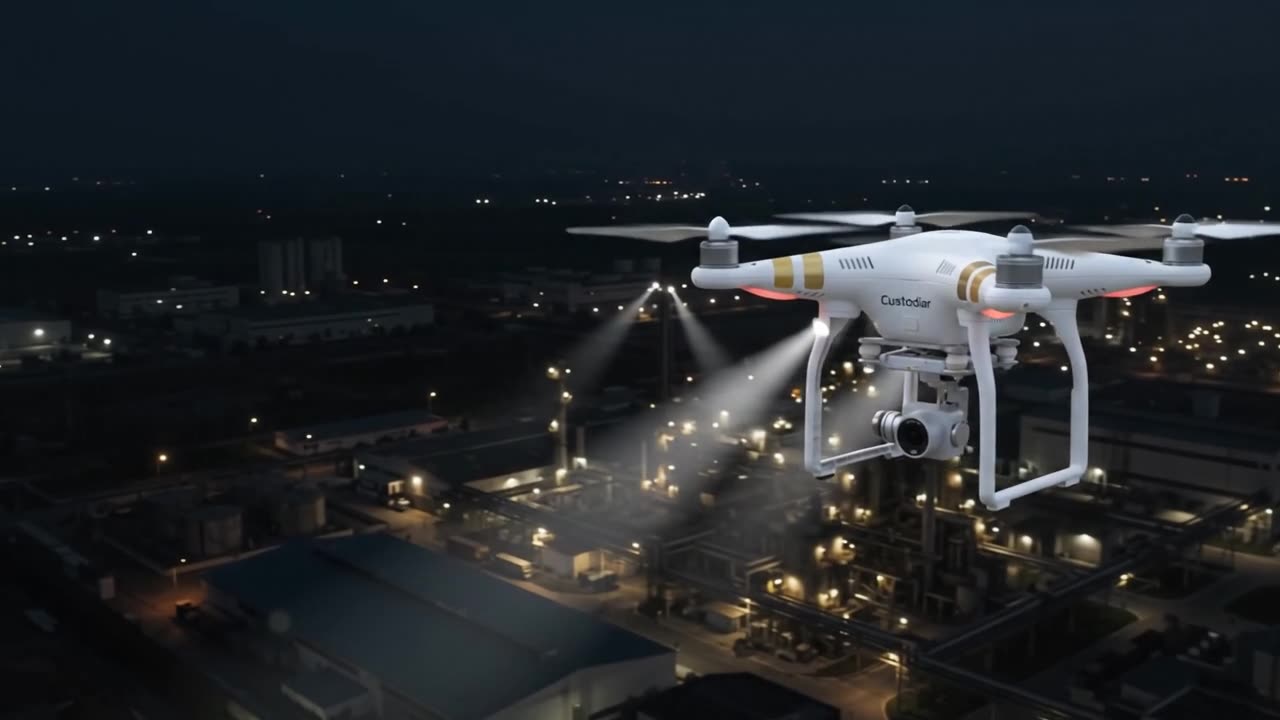
Drones in private security are used to widen coverage and obtain real-time aerial imagery: perimeter patrols, alarm verification, surveillance of large properties and support during incidents. They do not replace guards or the monitoring center: they complement them. In Colombia their commercial operation is governed by Aerocivil's RAC 100, so it is advisable to hire an operator that complies with the regulations and with personal data processing rules.
Security cannot always be limited to what is seen from the ground. Extensive perimeters, plants with hard-to-reach areas, construction projects or rural properties put any scheme based only on guards and fixed cameras to the test. Drones have become a specialized tool to close that gap, as long as they are used with judgment, method and regulatory compliance.
What is drone security?
It is the use of unmanned aircraft (UAS, RPAS or drones) as a support for private surveillance and security. The drone provides more coverage, more information and more response capacity: it reaches a point quickly, delivers real-time aerial imagery and lets you decide better before sending personnel.
It is a complementary means. It works best integrated with the monitoring center, response protocols and on-site surveillance, as part of a coordinated operation.
Main uses in corporate security
| Use | What it provides | Where it applies |
|---|---|---|
| Perimeter patrol | Scheduled or on-demand aerial rounds over fences, boundaries and access points | Plants, warehouses, industrial parks, extensive properties |
| Alarm verification | Visually confirm an event without exposing personnel | Facilities with perimeter sensors or CCTV |
| Surveillance of large areas | Greater coverage with fewer trips | Infrastructure, energy, mining, agribusiness, construction projects |
| Incident support | Aerial view to coordinate the response and protect the team | Any operation with a response plan |
| Inspection and documentation | Aerial record of site conditions, findings and evidence | Audits, insurance, security studies |
| Events and flows of people | Tracking of access points, occupancy and critical points, under applicable restrictions | Corporate events and logistics operations |
How a drone is integrated into the security operation
- Detection. An alarm, a camera, a guard's report or a scheduled round triggers the mission.
- Deployment. The authorized operator takes off and heads to the defined point or route.
- Real-time verification. The image goes to the control center and the supervisor, who validates whether it is a threat or a false alarm.
- Decision and response. The protocol is activated: containment, notification of the person in charge or on-site personnel support.
- Record and improvement. Evidence is saved and routes, schedules and protocols are adjusted based on the results.
Advantages over traditional schemes
- Coverage: a drone covers in minutes distances that take much longer on foot or by vehicle.
- Immediate visual information: improves the quality of the decision before mobilizing people.
- Personnel safety: lets you check risky areas without exposing guards.
- Deterrence: the presence of aerial surveillance usually increases the perception of control over the property.
- Traceability: missions generate records that support investigations and audits.
Limitations: what a drone does not do
- It does not replace physical response: it can observe but cannot detain or intervene; response personnel are needed.
- It depends on conditions: heavy rain, wind, low visibility and battery endurance limit the operation.
- Aeronautical regulations: there are restricted zones, heights and conditions; operating without compliance exposes you to penalties.
- Privacy: images may contain personal data and require processing in accordance with Law 1581 of 2012.
- It is not the solution for every property: in small or highly controlled facilities, the cost-benefit may not be justified.
Drone regulations in Colombia: the essentials
The operation of unmanned aircraft in Colombia is regulated by the Special Administrative Unit of Civil Aeronautics (Aerocivil) through RAC 100, which establishes the operation categories. In general terms:
- Operation categories: the scheme distinguishes open-category and specific-category operations; commercial operations or those beyond the limits of the open category are managed in the specific category.
- Aircraft registration: drones above a certain weight must be registered with Aerocivil.
- Personnel and authorizations: in the specific category, pilot certifications, operating authorizations and, depending on the case, additional permits are required (for example, night operations or beyond visual line of sight).
- Restricted zones: airports and their approach areas, military and police facilities, critical infrastructure and crowds are subject to special restrictions.
- Personal data: images and videos must be handled in accordance with Law 1581 of 2012.
The specific requirements (weights, heights, distances, certifications and permits) are updated. Before operating or hiring, confirm the current text of RAC 100 and the requirements on Aerocivil's official site, or ask the provider for documentation proving its authorization.
Checklist for hiring drone surveillance
- Security company with a valid license from the Superintendence of Surveillance and Private Security.
- Drone operation with the authorizations and certifications required by Aerocivil for the type of mission.
- Certified and trained pilots and observers, with flight logbooks.
- Insurance or a policy covering third-party damage arising from the aerial operation.
- Mission protocols: routes, schedules, weather conditions, aborts and contingencies.
- Integration with the monitoring center and the ground response plan.
- Image processing and retention policy in accordance with Law 1581 of 2012.
- Documented maintenance of equipment and replacement upon failure.
- Reports and indicators: missions executed, findings, verification times.
Sectors where we add the most value
- Industry and logistics: extensive perimeters, yards and warehouses.
- Energy, mining and infrastructure: assets spread over large or hard-to-reach areas.
- Construction: construction oversight, perimeters and after-hours verification.
- Agribusiness and rural properties: coverage of large areas with few resources.
- Ports, campuses and business parks: wide routes and multiple access points.
How to implement a drone security program
- Risk analysis of the property. Identify where the aerial view reduces risk and where it does not.
- Definition of missions and scope. Routes, frequency, schedules and use cases.
- Regulatory validation. Authorizations, airspace restrictions and data protocols.
- Integration with the operation. Monitoring center, guards and response plan.
- Pilot operation. Controlled tests and procedure adjustments.
- Continuous operation and improvement. Indicators, maintenance and periodic review.
Aerial security with Custodiar Air™
Custodiar Air™ is the aerial surveillance and security line of Custodiar LTDA. It uses drones as a specialized tool to widen coverage and obtain real-time visual information, and integrates it with physical security (Protect™), electronic security (Tec™) and risk management (Intel™). Each project is evaluated according to the needs of the operation and the aeronautical regulations in force.
Is your property a candidate for aerial surveillance?
We evaluate your operation and show you where drones add value and where they do not, integrated with surveillance, monitoring and technology.
Discover Custodiar Air™ → Message us on WhatsAppFrequently asked questions
What are drones used for in private security?
To patrol perimeters, verify alarms, watch over large properties, support incident response and document site conditions. They complement guards and the monitoring center; they do not replace them.
Is it legal to use drones for surveillance in Colombia?
Yes, as long as aeronautical regulations of Aerocivil (RAC 100), airspace restrictions and personal data protection rules are met. Commercial operations require the applicable authorizations.
Can a drone replace a guard?
No. The drone observes and verifies, but it cannot detain or intervene. Its value lies in providing information and coverage so that the human response is faster and better informed.
What regulations govern drones in Colombia?
Aerocivil regulates drones through RAC 100, which defines operation categories, registration, certifications and authorizations. Law 1581 of 2012 on personal data and restrictions on sensitive areas also apply.
Can drones fly at night or over people?
There are specific conditions and restrictions for night flights and flights over crowds, and they usually require additional authorizations. Check the current rules with Aerocivil and with your provider before planning the mission.
How is privacy protected in drone surveillance?
Defining a data processing policy: purpose, notices, restricted access, limited retention and traceability of queries, in accordance with Law 1581 of 2012 and its implementing regulations.

Custodiar LTDA TeamColombian integrated security company, supervised by the Superintendence of Surveillance and Private Security, with over three decades of experience (since 1990) and headquarters in Bogotá. Content prepared by our team based on regulations and industry best practices.